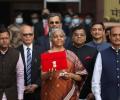
'India's output contraction in the previous year was among the worst in the world!'
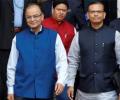
Securing the GDP estimates a month in advance would be a challenge and the government should take the Central Statistics Office on board before embarking on the new schedule for Budget presentation
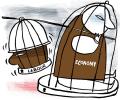
The implementation of four labour codes in one go from April 1 next year will usher in a new wave of reforms in industrial relations and also help in attracting more investments but employment generation will remain a key challenge in 2021. This year has also been a challenging year for the work force as well as for employers due to the outbreak of the COVID-19 pandemic. The government imposed a nationwide lockdown from March 25, which had an adverse impact on economic activities and resulted in exodus of migrant workers from large cities to their homes in the hinterland. Many migrant labourers lost their jobs and it took months for them to return back to their work places from their native places.

According to state government sources, not only did the governor insert some corrections, but he also initialled the final draft after those corrections had been made, reveals N Sathiya Moorthy.

hashtag 'Mori, please resign' was trending on Twitter in Japan

Seven years is a long time for any of Modi's promised actions to show up. If voters are angry and cynical today, it is because the rhetoric stings, argues Ramesh Menon.
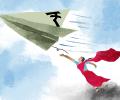
The challenges before the coming Budget are more daunting than those in 2021, reveals A K Bhattacharya.

Piloting the Specified Bank Notes (Cessation of Liabilities) Bill, Finance Minister Arun Jaitley said it will extinguish the government's liability towards scrapped notes and also eliminate the possibility of their bring used as parallel currency.

It is time he stood up and assured the middle class that they can count on him as one of their own, says Dr Sudhir Bisht.

'Are all roads in India privatised? Are governments not playing a role in airports or ports? If they (private players) want to set up lines for a specific requirement, I see no reason to object. It will expand the opportunity and passengers will also benefit.'
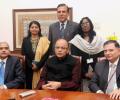
Senior New Delhi-based journalist R Rajagopalan, who has been closely following the Union Budget preparations since 1977, lifts the veil off India's most secretive operation.

In the Financial year 2013-14 there were encouraging signs on the foreign trade front as India's trade deficit recorded a sharp fall.
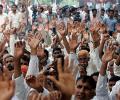
A BJP source admitted that a census will inevitably reconfirm the numerical majority of the OBCs. 'That will overturn social equations and consign the upper castes to a twilight zone of marginalisation. The RSS won't accept it.' Radhika Ramaseshan reports.

In 2014-15, capital expenditure in the April-September period was Rs 99,100 crore.

Indian women have education, inspiration and perspiration -- but not enough employment, points out Mahesh Vyas.

Tokyo Governor Yuriko Koike has pledged to win public support for the Games, although a media survey showed a majority think they should be cancelled or postponed again.
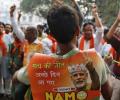
'Success will require political skill, not just economic expertise'
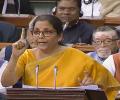
'The economy needed 3 or 4 major fixes. The major one was, of course, the direct tax structure, but we ended up complicating the existing convoluted tax structure,' says M R Venkatesh, chartered accountant and lawyer.

India's fiscal deficit trends are a bit like an alcoholic trying, unsuccessfully, to reform. Virtue does not last for too long, says Shankar Acharya.
The average rating was seven out of 10.

At this point of time, the requirement of the economy is obviously more investment, which will create more jobs and increase purchasing power that will sustain a high level of production, says K M Chandrasekhar.

'The bad dream can turn into a ghoulish nightmare for the BJP if the Gujjars in Rajasthan and the Patels in Gujarat, both BJP-ruled states, were to fish in troubled waters and relaunch their respective agitations for quotas in government jobs,' warns Rajeev Sharma.
The Bill states a worker will be paid twice his or her wage if he or she is allowed to work overtime. A majority of workers in India worked more than 48 hours in a week, which is higher than the International Labour Organisation's prescribed time-limit.
The PMO should also present an annual report, on the state of politics and society
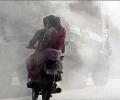
Despite a 187 km, seven-line metro network carrying 2.4 million commuters every day, private vehicles rose 92% over the last 15 years

'We need to put aside our anxieties about the Budget for now and possibly for long, and carry on as best as we can,' advises Shreekant Sambrani.

Since 2000-01, the Indian economy has shown the tendency of being unable to absorb all domestic savings as investments.

Whereas the headline growth rate appears very respectable, India needs faster to growth to generate jobs.

High-pitched identity politics, which is the norm in the northeast, has continued to compound the boundary problem.
Around 81 per cent of the workers constitute the unorganised sector - devoid of any social security cover and outside the purview of a complex set of labour laws.
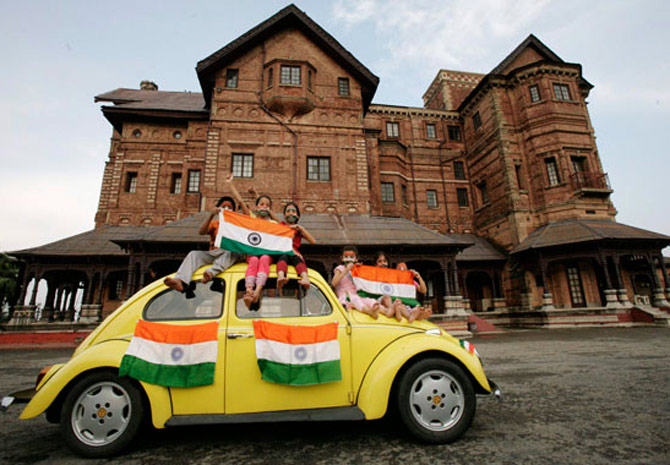
The poll of over 30 economists, taken in the past week, showed Asia's third largest economy will expand 7.8 percent in the fiscal year ending March 2017.

Though General Naravane's visit will not deal with 'impermanent' issues like the changing stands of politicians, it will certainly reinforce the deeper 'permanent' links between the people of Nepal and India. Time will hopefully tackle the present impermanence of the Sino-Nepalese romance, notes Claude Arpi.

'The finance minister and the government have met the immediate challenge. The wine this time is new and also in a new bottle, which, though not full, is less than half empty.'
The situation could become more acute as millions of migrants who had returned to their villages during the lockdown come back to the towns for higher wages and better livelihoods.
Neither the CAA nor the proposed NRC are important enough to stake the well-being of so many or stake economic growth. Getting growth back on track is more important, notes Mahesh Vyas.
Taking away free healthcare facilities, as recommended by the Aayog, would place a huge burden on the people, especially in rural areas, says Devanik Saha.

anata Dal-United president Sharad Yadav says leaders of all 11 parties who've formed a new front will meet after the current Parliament session to finalise a name, coordination strategy and programmes. Mayank Mishra reports

The most serious recommendations to change the financial year came in the years preceded by deficient rainfall. The Jha committee was formed after droughts in 1979-80 and 1982-83, reports Rishika Pardikar/IndiaSpend.
A CNN-IBN-Axis MyIndia poll about the Modi Government's first year in power assessed the government's performance from a layperson's perspective.

IMF attributes the slower growth rate to supply-side bottlenecks.
